IBM SPSS Statistics - Hypothesis 3 Statistics
Version used: Version 31.0.1.0 (49)
PROCESS Version used: v4.2_beta
H3 *Unexpectedness mediates - Oddity raises perceived unexpectedness, and unexpectedness carries the effect of oddity on comfort.
- PROCESS Model 4
- 10,000 bootstraps
- HC4
The PROCESS regression
-
Menu:
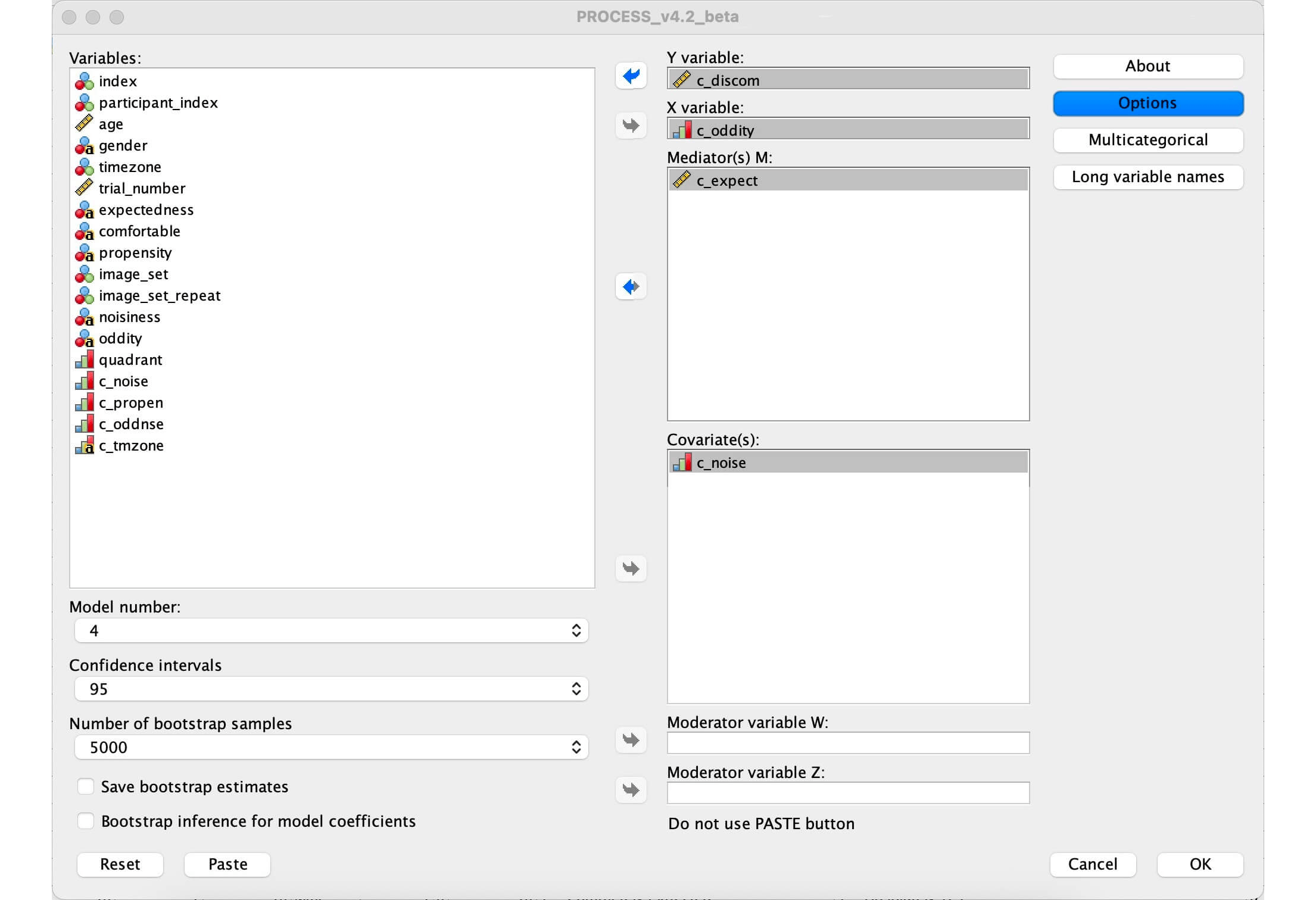
Analyze → Regression → PROCESS v4.2 by Andrew F. Hayes - In the dialog, select:
- Y variable:
c_discom - X variable:
c_oddity - Mediator(s) M:
c_expect - Covariate(s):
c_noise - Model number:
4 - Confidence intervals:
95 - Number of bootstrap samples:
5000
- Y variable:
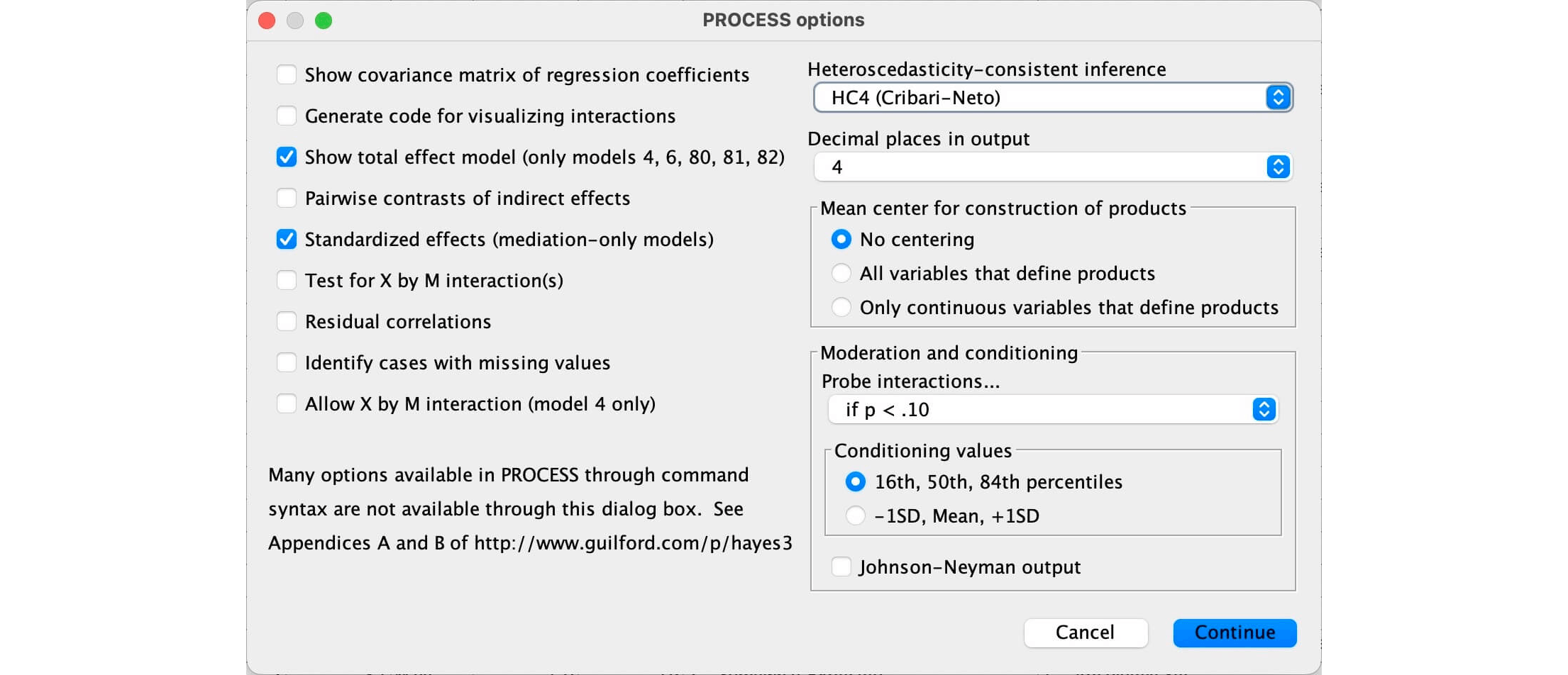
- Select the Options button:
- Tick:
- Show total effect model… → (Y on X without M) → *needed for the total effect *c**
- Standardized effects → gives the completely standardised indirect effect as the effect size
- Heteroscedasticity-consistent inference → select HC4 (Cribari-Neto) from the dropdown
- Tick:
- Continue, & OK
Results (Part 1 - from PROCESS Dialog)
-
Output:
-
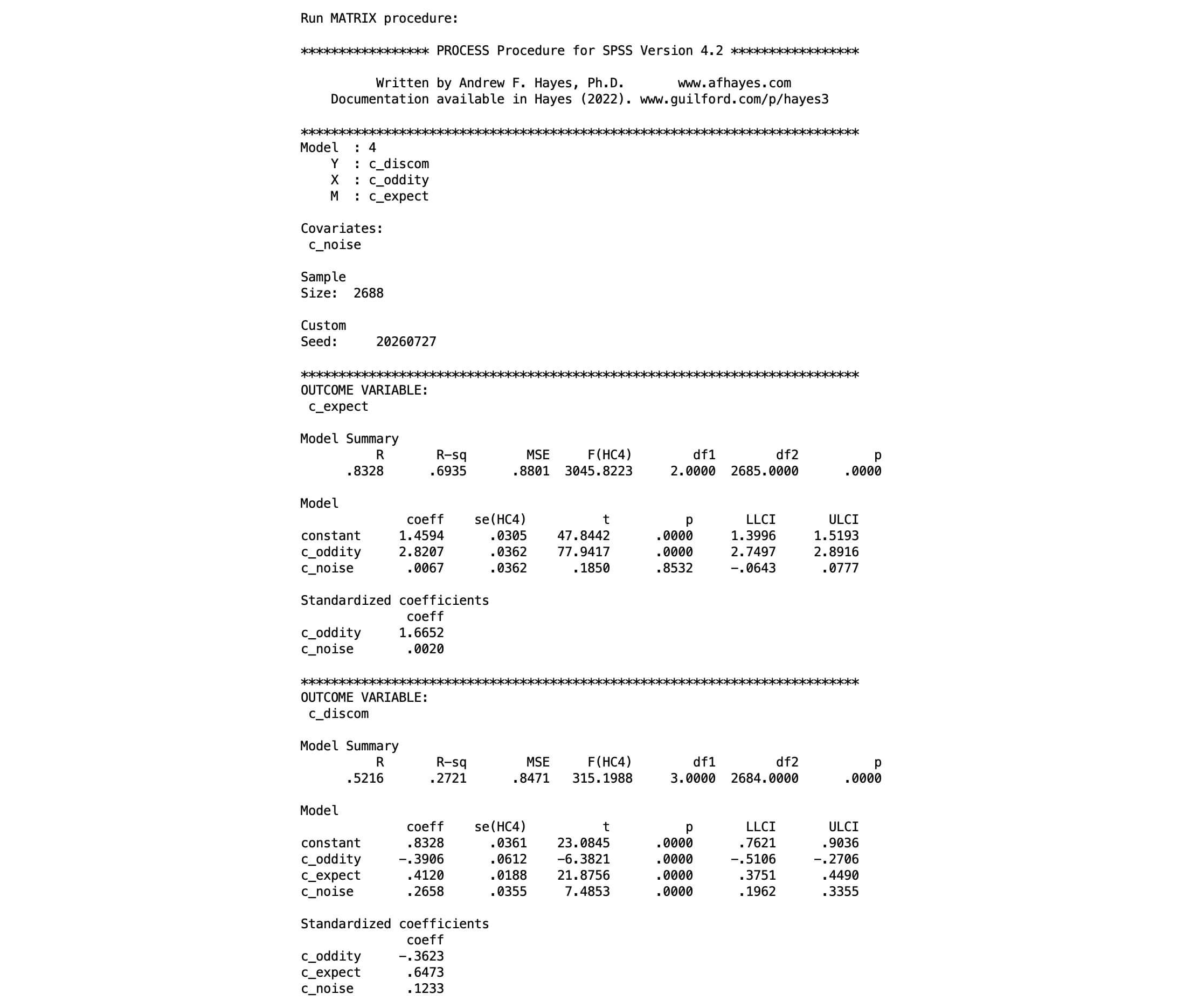
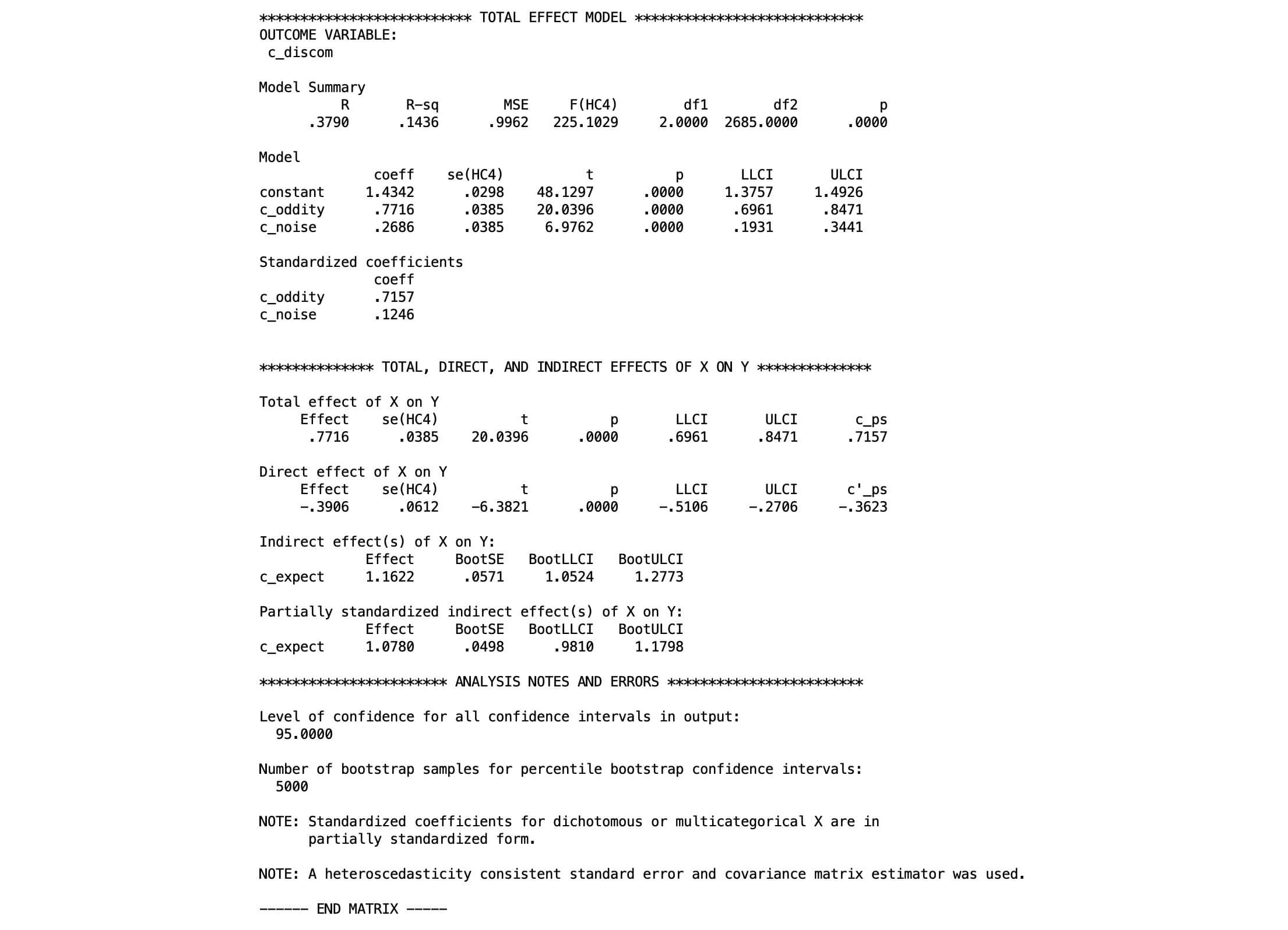
H3 is supported - the indirect effect is large and its CI is nowhere near zero. But the direct effect flips sign, which is the interesting part and needs expanding on.
-
The paths
Path Effect SE(HC4) 95% CI t p a (oddity → unexpectedness) 2.821 .036 [2.750, 2.892] 77.94 <.001 b (unexpectedness → discomfort, controlling X) 0.412 .019 [0.375, 0.449] 21.88 <.001 c (total) 0.772 .039 [0.696, 0.847] 20.04 <.001 c′ (direct) −0.391 .061 [−0.511, −0.271] −6.38 <.001 a×b (indirect) 1.162 .057 (BootSE) [1.052, 1.277] - - - Partially standardised indirect effect = 1.078, 95% CI [0.981, 1.180].
- Model fit: M model R² = .694, F(2, 2685) = 3045.82, p < .001. Y model R² = .272, F(3, 2684) = 315.20, p < .001.
-
⚠️ ⚠️ ⚠️ HOWEVER, running PROCESS 4.2 from the dialog randomises the random seed, so replication is not possible. ⚠️ ⚠️ ⚠️
The PROCESS regression (replicable)
-
To run the regression in a replicable manner, one needs to run the macro with a random seed set - and this can only be done from the syntax command.
-
Menu:
Window → Go to Designated Syntax Window -
Paste the following syntax:
PROCESS y=c_discom /x=c_oddity /m=c_expect /cov=c_noise /model=4 /boot=10000 /conf=95 /hc=4 /effsize=1 /stand=1 /total=1 /seed=20260727. -
Then right-click and
Run All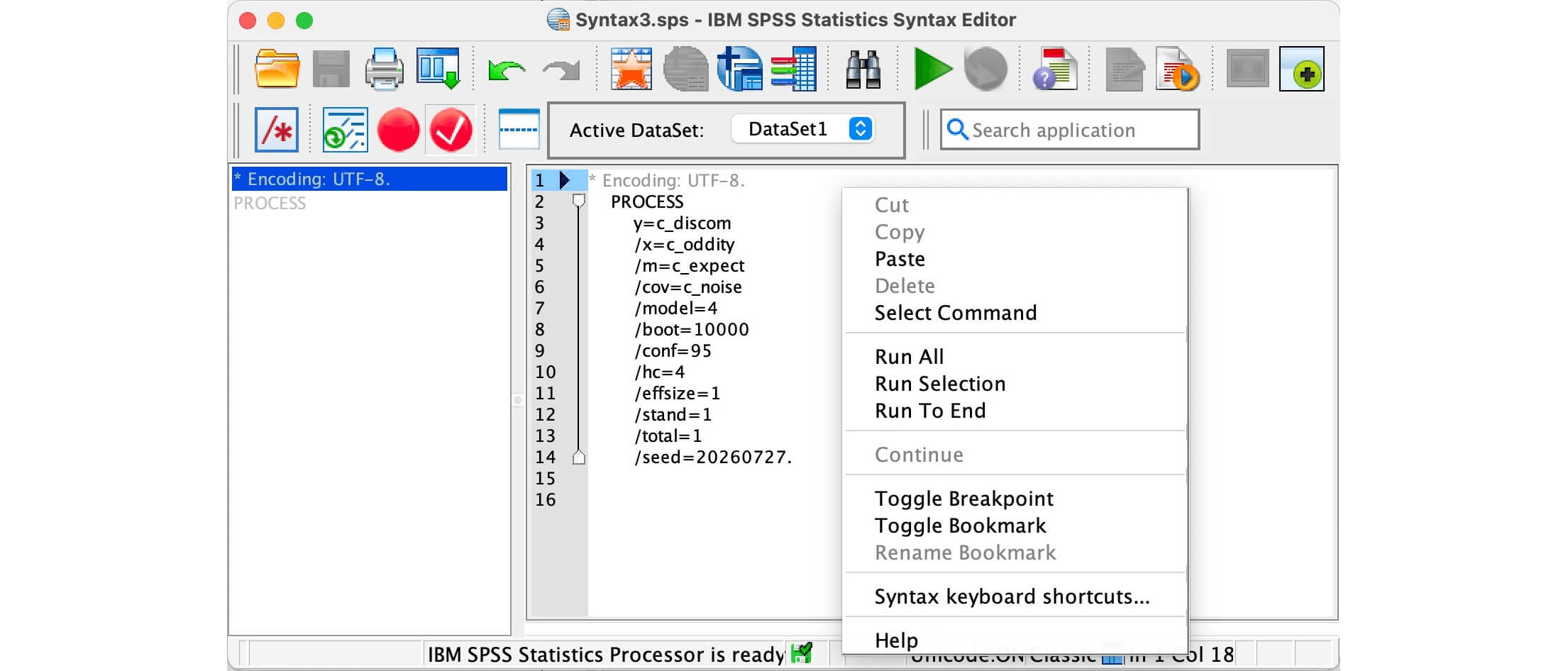
Results (Part 2 - from PROCESS Syntax command)
-
Output:
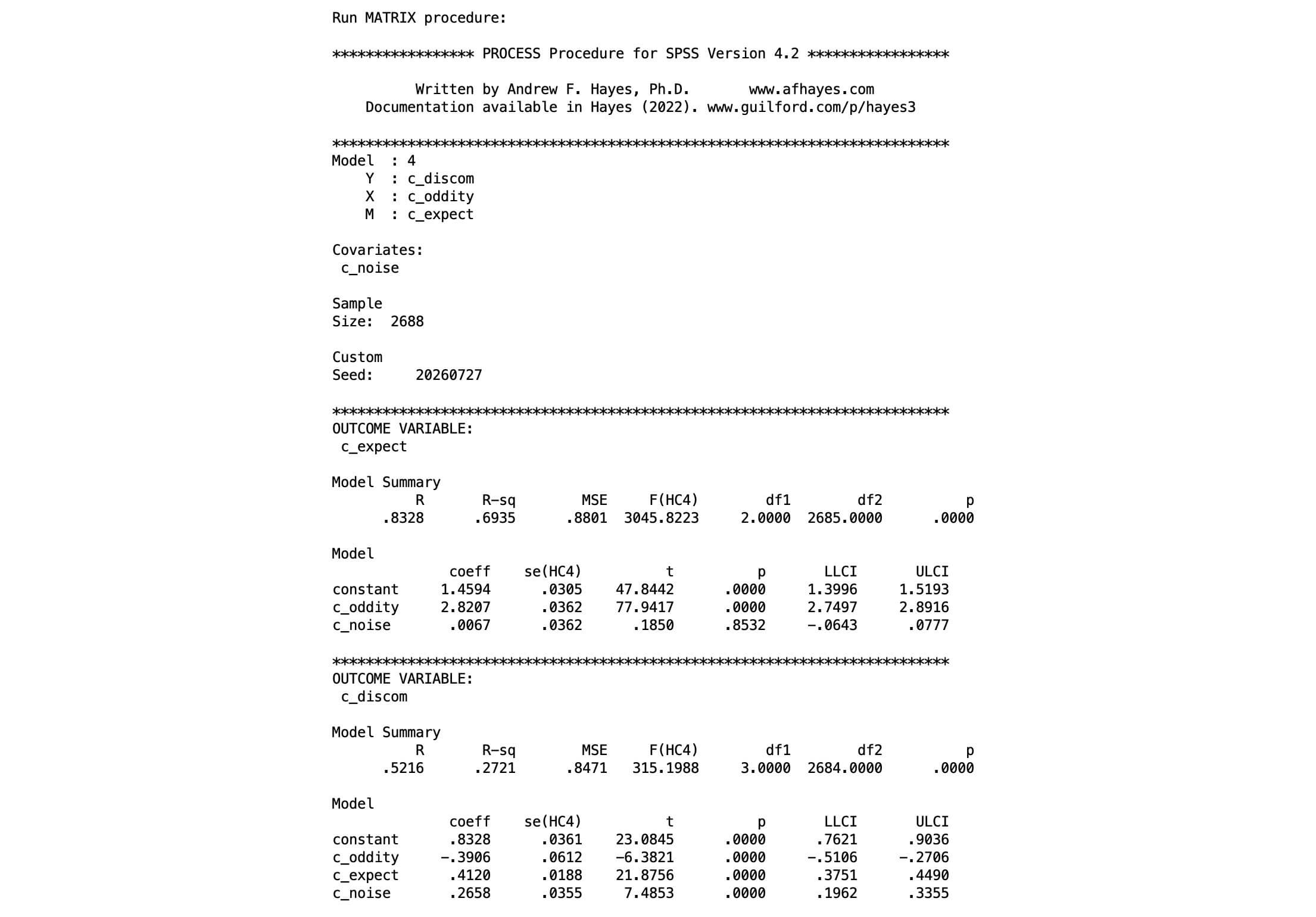
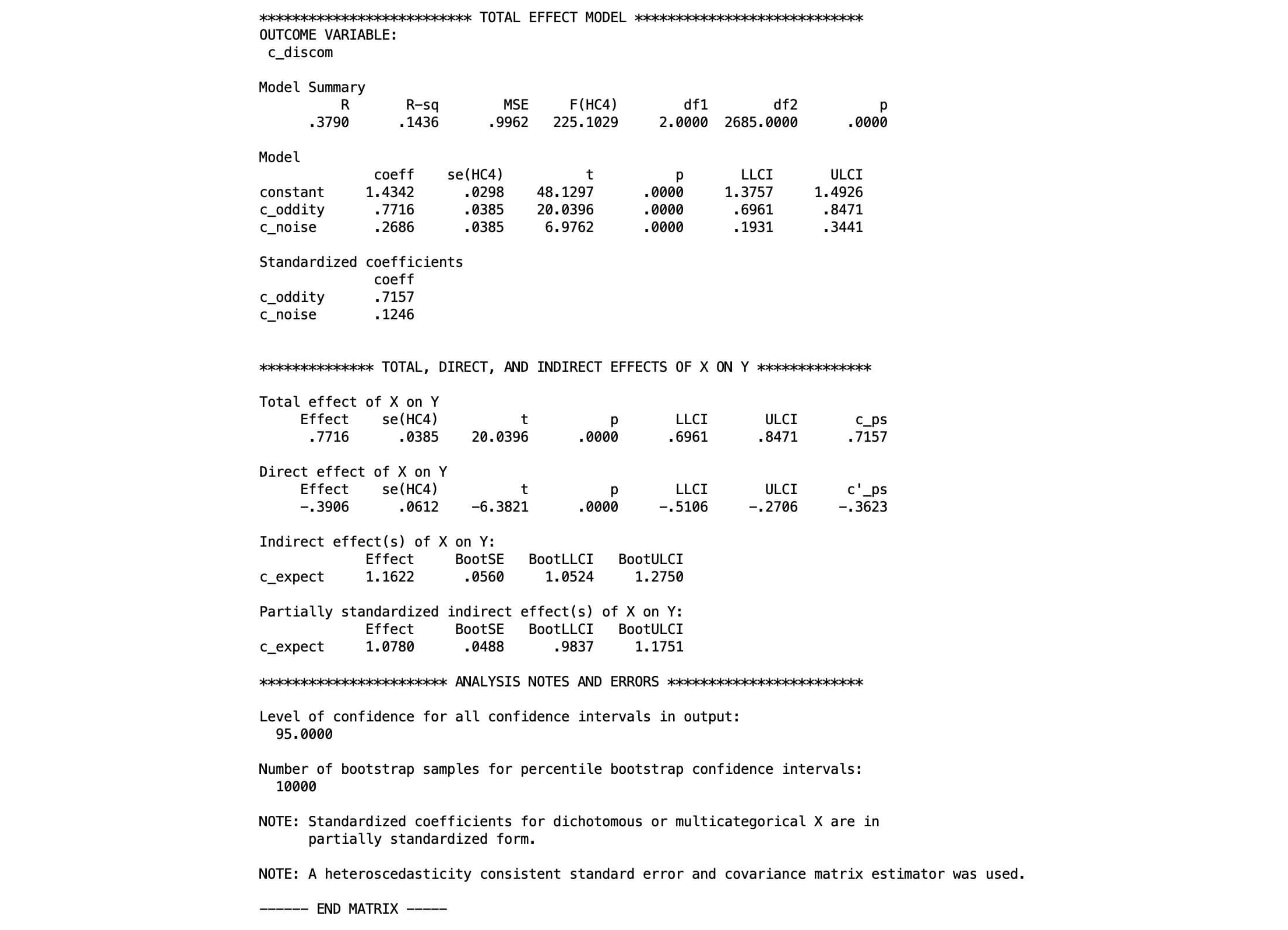
-
Substantively identical. Every OLS estimate - a, b, c, c′, and all model summaries - is unchanged.
Bootstrapping only affects the indirect-effect CI and made it reproducible, and 10,000 samples tightened the bootstrap slightly.
-
The paths
Path Effect SE(HC4) 95% CI t p a (oddity → unexpectedness) 2.8207 .0362 [2.7497, 2.8916] 77.9417 <.001 b (unexpectedness → discomfort, controlling X) .4120 .0188 [.3751, .4490] 21.8756 <.001 c (total) .7716 .0385 [.6961, .8471] 20.0396 <.001 c′ (direct) −.3906 .0612 [−.5106, −.2706] −6.3821 <.001 a×b (indirect) 1.1622 .0560 (BootSE) [1.0524, 1.2750] - - - Partially standardised: total c_ps = .7157, direct c′_ps = −.3623, indirect = 1.0780, BootSE = .0488, 95% CI [.9837, 1.1751].
- M model: R² = .6935, F(2, 2685) = 3045.8223, p < .001. Y model: R² = .2721, F(3, 2684) = 315.1988, p < .001. Total-effect model: R² = .1436, F(2, 2685) = 225.1029, p < .001.
-
What this shows
H3 is supported - the bootstrapped indirect effect is 1.1622, CI [1.0524, 1.2750], well clear of zero. Oddity raises perceived unexpectedness by 2.8207 points on the 5-point scale - 1.6652 SD of
c_expect, derived - and each unit of unexpectedness adds 0.4120 to discomfort.The indirect effect (1.1622) exceeds the total effect (.7716), which forces the direct effect negative. This is inconsistent mediation: indirect and direct pathways run in opposite directions and partially cancel. Oddity’s effect on discomfort travels through perceived unexpectedness, and holding unexpectedness constant, oddity is associated with less discomfort.
Noise dissociates cleanly across the two models - significant on discomfort (b = .2658, p < .001) but null on unexpectedness (b = .0067, p = .8532). Activity level therefore acts on the outcome without touching the mediating construct.