Finally, I Can Say It
“For someone so clever, you’re really stupid sometimes.”
I heard some version of that sentence more times than I can count - the one that starts as an insult and, without meaning to, hands you the actual finding. Because the honest answer was never about how much I understood. It was about whether what I understood could get out of my head and into words - in the moment it was needed - in a shape you could use.
I’m not going to argue that in terms of intelligence. That argument goes nowhere and it isn’t the point. The point is narrower and more useful: there is a gap between what a person knows and what a person can say, and for some of us that gap is wide and load-bearing, and for the first time in my adult life a tool exists that closes it. Not by making me cleverer. By getting the signal out.
This is an essay about that tool - what it fixed for me specifically, what it’s actually good for as distinct from what it’s currently being blamed for, and why I think “AI took something from us” and “AI is a disability accommodation” are, for people wired like me, the same argument wearing two different tempers.
Two kinds of forgetting
ADHD and memory are tied together at the root - working memory, specifically, the ability to hold something in mind long enough to act on it. 1 For me that has meant a life of good intentions with no way to keep them in the room. The commitment made in good faith and gone by the time it mattered. The instruction understood perfectly and lost three minutes later, not through carelessness but through a system that was never built to hold it.
What changed is not that I remember more. It’s that I no longer have to. I can ask, and be told - now, mid-task, without waiting for a diary entry I wouldn’t have made anyway, or a person I’d have had to interrupt and then feel the cost of interrupting. An external memory that doesn’t tire of me and doesn’t read the asking as a character flaw. That is the ADHD half of this, and it is the smaller half.
The writing I couldn’t do
The autistic half is writing itself, and it needed two specific things out of the way before it could happen at all.
The first was dyslexia - a neurobiological difficulty, most often rooted in the phonological end of language, that scrambles the mechanical link between what a person means and the letters that are supposed to carry it. 2 I have spent whole afternoons on a single paragraph, not because the paragraph was hard, but because getting it from my head to the page kept losing something in the transfer, and I couldn’t always tell what.
The second was harder to name, because the closest clinical word for it - anomia - technically belongs to something else: sudden, acquired word loss after a stroke or a brain injury. 3 What I have is not that. It is a chronic, lifelong version of the same failure - the meaning fully present, the specific word missing on demand - and it turns out this pattern is well documented outside the stroke literature too, in children whose word-finding difficulties turn up years before anything else does, and who go on, at a striking rate, to be diagnosed with ADHD. 4 I was one of those children. I just didn’t get the second half of that sentence until I was fifty.
Between the two of them, dyslexia and word-finding failure took a piece of writing that should have taken twenty minutes and turned it into an afternoon, or into nothing at all - because the failure mode of “I know exactly what I mean and cannot get it out” doesn’t look like not trying. It looks, from outside, exactly like not having anything to say.
Then there’s a third thing, which isn’t a disability in any manual but has cost me just as much: I say things plainly, in the order I think them, without the social sanding-down most people apply automatically. I have learned, slowly and at real cost, which sentences need the sanding and which don’t - and I still get it wrong often enough that “you can’t say that like that” has been one of the most repeated notes of my adult life.
AI does not fix any of these three things about me. What it does is sit between the thought and the page, catching the letters that scrambled, supplying the word that wouldn’t come, and softening the edge I can’t reliably judge on my own before it leaves the room. It is not writing for me. It is translating me into a form that survives contact with you.
What the room is actually angry about
I want to be honest about the moment I’m writing this in, because it isn’t a friendly one for saying any of the above out loud.
At commencement ceremonies across the United States this year, graduates booed speakers who spoke well of AI - at the University of Arizona, at the University of Central Florida, at Middle Tennessee State University, and elsewhere. 5 I understand the anger. I was in technology through the dot-com boom, and I know what a bubble sounds like from the inside. But this is not that, and the difference matters: a Harvard economist found that investment in AI infrastructure accounted for roughly 92% of US GDP growth in the first half of 2025 - take it out, and growth for that period was close to flat. 6 The dot-com bubble inflated a sector. This one is propping up the headline number for the whole economy while, by plenty of measures, the economy underneath it is barely moving. That is a genuinely new kind of hype, and the anger is not confused for having noticed it.
Some of that anger is aimed at the right target and lands on the wrong one. Howard Gardner’s theory of multiple intelligences - interpersonal, the reading of other people, and intrapersonal, the reading of oneself - describes exactly the two capacities that customer service and sales are actually built on. 7 Both are being handed to AI early and confidently, on the assumption that talking to people is a solved problem. I think that assumption is simply wrong, not premature. Reading another person well enough to sell to them, or to calm them down, or to know which sentence lands and which one doesn’t, runs on too many human nuances - tone, history, the thing that isn’t being said - for a system with no interior life of its own to ever fully carry. There is a learning curve here, and companies are a lesson or two into it. What they will learn is not how to get AI the rest of the way there. It’s where the wall actually is.
A tool has no verdict of its own
Somebody at a building site hammers in a nail with a cordless drill, and struggle to get the work done. And the men next to him shake their heads and agree that drills should be banned. It’s a joke because everyone can see the drill isn’t the problem.
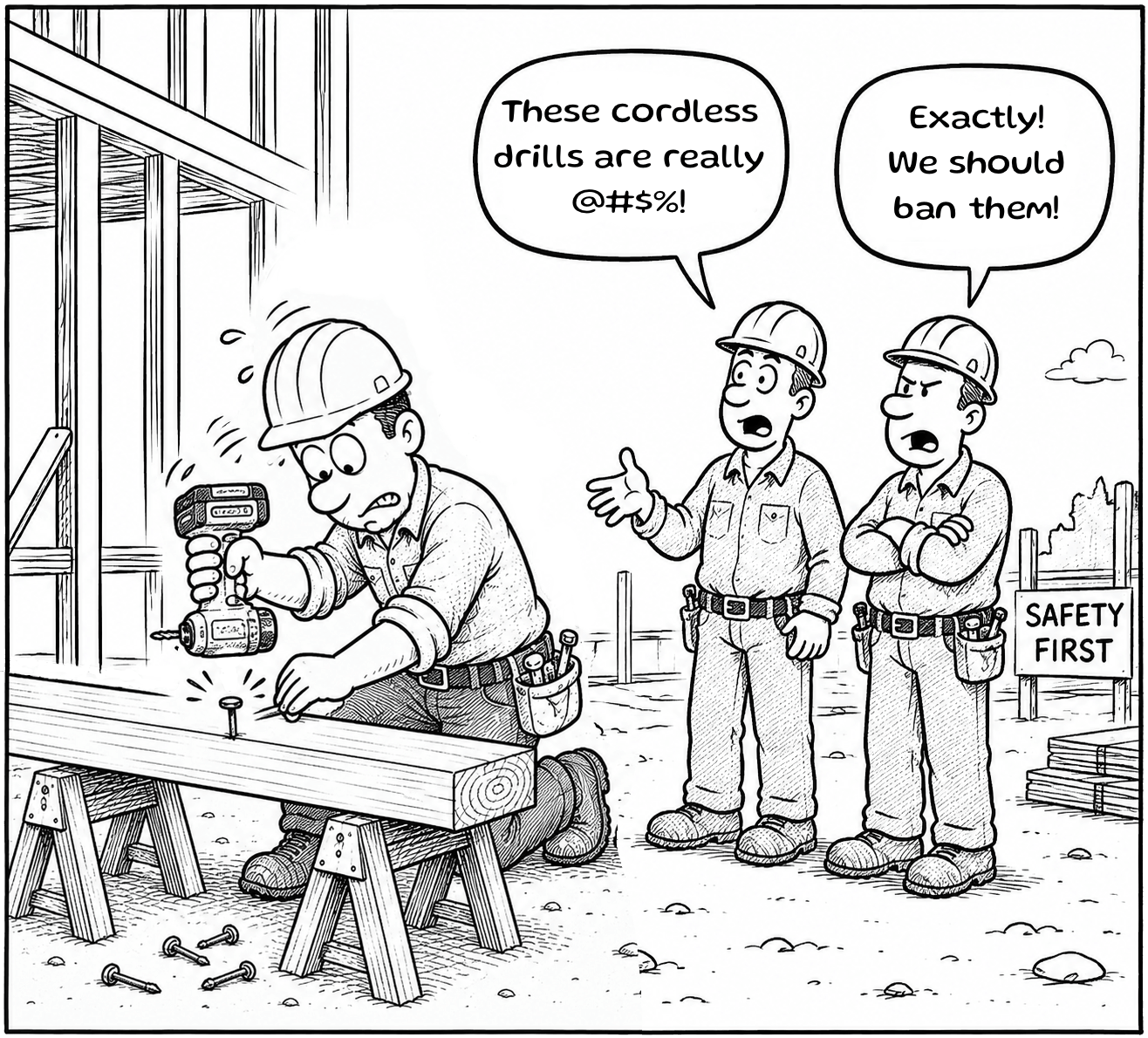
Voices for bans and boycotts of new technology have a long history of aiming at the tool instead of the hand - it happened to cars, to looms, to the printing press - and it is happening again now.
A tool is only as good as the person operating it. When people say “AI is bad,” what they are usually describing, without noticing, is a bad operator - which means the thing actually being criticised is a person, or a choice, or an incentive, wearing the tool as a mask. That reframe matters, because it changes where the responsibility sits. And it leads directly to the idea that actually explains most of what’s going on: AI doesn’t have values or a skill level of its own. It has yours.
But it does add to something. In the past, using a piece of knowledge meant two separate jobs before you ever got to use it: you had to learn it, and you had to remember it. Both were real work, and both sat between you and the answer. AI removes that barrier, and I’m not going to pretend that’s a small thing - it’s a huge one.
What it doesn’t remove is everything on the other side of that barrier. In the past, a university degree never meant you could actually do the job; it meant you’d cleared the learning-it-and-remembering-it step, and the skill itself - taking several pieces of information and combining them into the one answer that actually fits this situation, not the textbook one - still had to be built on top of that, the slow way, through application. That skill hasn’t gone anywhere, and AI doesn’t hand it to you. Part of it is knowing which pieces genuinely add up to the answer. The other part, the part people underrate, is knowing which options are technically valid somewhere and still wrong here, and taking them back off the table. Both halves are still yours to do.
Amplifier
AI isn’t only access to knowledge - it’s also an amplifier. It will clean up the signal - fix the scrambled word, straighten out a dyslexic sentence - but that’s not the same as improving what’s being said. An amplifier makes whatever goes into it louder; it doesn’t upgrade the judgment behind it.
Feed it a good idea and it gets a voice it didn’t have before. A good developer, using it well, ships faster. But the same amplifier serves a bad actor faster access to doing harm, and a bad developer more code, produced faster, in worse shape than before - because volume was never the bottleneck for either of them, judgment was, and the amplifier does not supply judgment. It only makes whatever judgment was already there travel further.
Every fight currently being had about whether AI is good or bad is, underneath, a fight about what’s being fed into it - and both sides are technically correct, about different people.
Equalizer
The amplifier framing explains outcomes. It doesn’t explain something else I’ve watched happen to myself, which is less about volume and more about access. For people carrying certain disabilities, AI isn’t turning the volume up. It’s opening a door that was locked.
Dyslexia. 2 The chronic word-finding difficulty some people call anomia. 34 Dyscalculia, the mathematical equivalent - a specific, neurobiological difficulty with number sense and calculation that has nothing to do with general intelligence and everything to do with one particular pipeline. 8 All three can now be substantially worked around, in real time, by a tool that costs a subscription instead of a specialist.
I know exactly what that used to cost, because I’ve paid it. Publishing a book used to mean paying an editor, properly, for the specific labour of turning a dyslexic, anomic first draft into something a stranger could read without noticing the seams. That is no longer a five-figure gate standing between an idea and a reader. It is a fraction of what it was, and the gap it closes is not “can this person write” - I always could - but “can this person’s writing survive the trip from their head to the page without a paid intermediary standing in the middle of it.”
There’s a second, larger equalizing effect underneath the disability-specific one, and it runs through something David Epstein argued in Range: that generalists, not specialists, tend to do better in a world of genuinely novel problems, because specialization trains you to be excellent inside a narrow lane and helpless outside it. 9 AI has since gone and hollowed out a great deal of exactly that narrow-lane specialist value - the kind of skill that used to be worth a career is now worth a prompt. That’s a real loss, and it lands hardest on people who spent decades building depth and no width, because they now have no fallback skill to generalise into.
It also means, and I’ll say this as my own reasoned view rather than something I can point to a study for, that generalists are in a stronger position to use AI well than specialists are. A person who has had to move across domains their whole working life is more practised at the thing AI most needs from its operator: noticing when an answer is confidently wrong, because you’ve been the person figuring out an unfamiliar field without an expert in the room often enough to know what that actually feels like. Specialists trust the fluency. Generalists have had more practice mistrusting it.
What it’s costing us
None of that is a case for looking away from the damage, and there is real damage.
A Stanford analysis of payroll data covering millions of workers found that employment for 22-to-25-year-olds in the occupations most exposed to AI has fallen roughly 13% since 2022, and is currently shrinking at 3.8% a year - while workers over 30 in the same exposed occupations grew employment by 6 to 12% over the same period. 10 Junior roles are not a nice-to-have. They are how a profession grows its next generation of judgment, and they are being quietly removed from underneath a workforce that still needs somewhere to start.
I don’t think the fix is banning the tool. I think organisations need to rediscover a role that used to be ordinary and has quietly disappeared: the senior person whose job includes developing the junior ones, the way it was simply assumed to work in the 1930s and 40s, before “efficiency” came to mean removing exactly that overhead. If AI is going to do the routine work that used to teach a beginner the trade, then teaching the beginner the trade has to become somebody’s actual job again, on purpose, rather than an accident of being handed easy tickets.
Humans with AI, not humans or AI
Put the last few sections together and this is where they land - my own conclusion, reached from my own life, not one handed to me: AI amplifies and equalizes at the same time, and most of the current argument about it flattens both effects into a single word - “slop” - that explains nothing and forecloses the actual question, which is about degree, intent, and what the human at the other end contributed. The binary version of this fight - AI good, AI bad, human-made versus synthetic - is analytically empty. The only sentence that survives contact with my own life is: humans, with AI, not humans, or AI.
I want to end on the part of that sentence that is mine specifically. I have spent this whole essay describing a tool that gets around dyslexia, gets around a form of chronic word-finding failure, and gets around a bluntness I can’t always self-edit in time. Every one of those is a documented disability, or close enough to one that the distinction is academic. The Convention on the Rights of Persons with Disabilities defines disability as an impairment meeting the barriers around it, not as something sitting inertly inside a person, and it obliges the accommodation of exactly that meeting point. 11
So here is the plain claim. If a screen reader is a disability accommodation, and a wheelchair ramp is a disability accommodation, then for a growing number of us, so is AI. Not a convenience. Not an unfair advantage. The thing that lets what’s actually in my head make it as far as this sentence - the one you just read, all the way to the end, in a form you could use.
⁂
-
Alderson, R. M., Kasper, L. J., Hudec, K. L., & Patros, C. H. G. (2013). Attention-deficit/hyperactivity disorder (ADHD) and working memory in adults: A meta-analytic review. Neuropsychology, 27(3), 287–302. DOI: 10.1037/a0032371 ↩
-
Lyon, G. R., Shaywitz, S. E., & Shaywitz, B. A. (2003). A definition of dyslexia. Annals of Dyslexia, 53, 1–14. DOI: 10.1007/s11881-003-0001-9 ↩ ↩2
-
Anomia in the clinical sense - a symptom of aphasia, most often following stroke or brain injury - is an acquired, usually sudden loss of word retrieval. 4 documents the chronic, developmental version of the same failure that this essay actually describes; I use “anomia” here for the everyday word-finding difficulty, not the acquired clinical syndrome, and I want that distinction on the record rather than borrowed quietly. ↩ ↩2
-
Messer, D., & Dockrell, J. E. (2006). Children’s naming and word-finding difficulties: Descriptions and explanations. Journal of Speech, Language, and Hearing Research, 49(2), 309–324. DOI: 10.1044/1092-4388(2006/025) See also Ganelin-Cohen, E., Pilowsky Peleg, T., Leibovich, N., Bachrach, E., & Watemberg, N. (2024). Word-finding difficulties as a prominent early finding in a later diagnosis of attention deficit hyperactivity disorder. Neuropediatrics, 55(1), 24–29. DOI: 10.1055/s-0043-1776356 - among children with a history of word-finding difficulty, 93% went on to be diagnosed with ADHD, against 42% of children without that history. ↩ ↩2 ↩3
-
Booing of AI-positive commencement remarks was widely reported across the US press in May 2026, including by NPR, CNBC, and Fast Company. This is journalism, not peer-reviewed research, and I am citing it as a record of a public event rather than as evidence of anything beyond that event. ↩
-
Furman, J. Post on X, 27 September 2025; analysed in Fortune, 7 October 2025. Furman is a Harvard Kennedy School economist and former chair of the US Council of Economic Advisers, working from US Bureau of Economic Analysis data. He has since noted the counterfactual is imprecise - without the AI buildout, interest rates and energy prices would likely be lower, which would itself support some growth elsewhere - so the 0.1% figure is best read as illustrating the scale of AI’s contribution, not as an exact estimate of growth in its absence. ↩
-
Gardner, H. (1983). Frames of mind: The theory of multiple intelligences. Basic Books. ISBN: 978-0465025107 ↩
-
Butterworth, B., Varma, S., & Laurillard, D. (2011). Dyscalculia: From brain to education. Science, 332(6033), 1049–1053. DOI: 10.1126/science.1201536 ↩
-
Epstein, D. (2019). Range: Why generalists triumph in a specialized world. Riverhead Books. ISBN: 978-1509843497 ↩
-
Brynjolfsson, E., Chandar, B., & Chen, R. (2025, revised 2026). Canaries in the coal mine? Six facts about the recent employment effects of artificial intelligence. Stanford Digital Economy Lab working paper. https://digitaleconomy.stanford.edu/publications/canaries-in-the-coal-mine/ Based on payroll data covering 4.6 million workers across more than 730 occupations, sourced from ADP. ↩
-
United Nations. (2006). Convention on the Rights of Persons with Disabilities, Article 2. https://www.un.org/development/desa/disabilities/convention-on-the-rights-of-persons-with-disabilities.html A treaty text, cited for its definition and its accommodation obligation rather than as a research finding. ↩